Introduction
The General Assembly is the most powerful branch of the North Carolina government and the closest to the people, so it should also be accountable and responsive to North Carolina citizens.
There are two basic models for what makes a legislature effective. The first is a citizen legislature, where legislators meet part-time and spend most of their time in their home districts. The second is a professional legislature, where legislators work as full-time employees who can devote most of their time to legislative work. Both models have their strengths and weaknesses. An ideal legislature would operate under the best features of both models, counteracting the negative aspects of both.
North Carolina traditionally follows the citizen-legislature model. Nevertheless, the growing demands on legislators and the longer sessions in which they meet have led the National Conference of State Legislatures to characterize the General Assembly as a “hybrid” state, where legislators typically “spend more than two-thirds of a full-time job being legislators.”
Despite that, North Carolina has one of the lowest-paid legislatures in the country. Legislators in North Carolina make roughly a third of the median salary of states that provide legislators an annual salary. Only five states pay their legislators less. North Carolina also has relatively low per diem and mileage reimbursement rates. Low legislative pay makes it difficult for those neither retired nor wealthy to serve. In a survey of state legislators, 72 percent said that the current salary level made recruiting candidates more difficult.
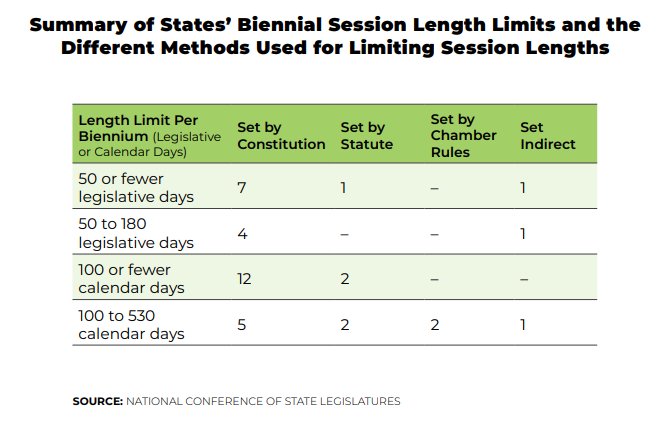
While legislators’ salaries have stagnated, their workload has grown. From the 1973–74 to the 2011–12 biennial sessions, the legislature usually met for fewer than 175 legislative days (the days each chamber meets) spread over fewer than 300 calendar days. Since then, sessions have grown to be over 200 legislative days across 350 calendar days regularly. Longer session lengths are associated with higher costs, shifts in power away from legislators who are not in leadership, and more missed days of voting.
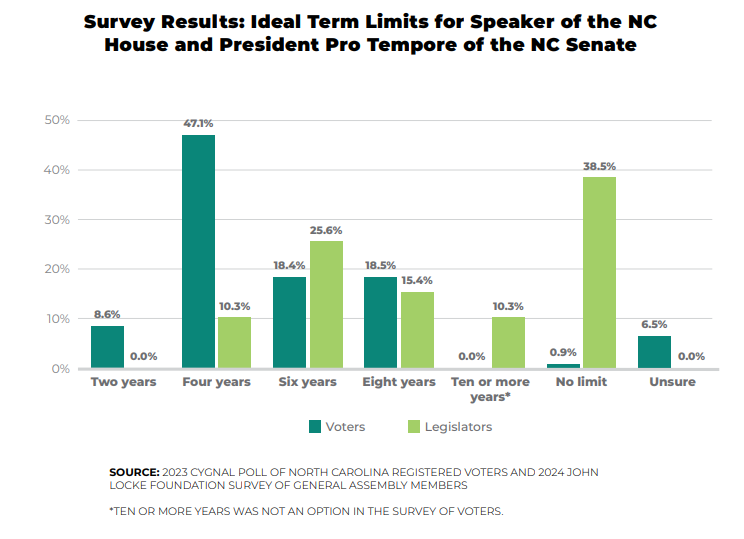
Something else that has stagnated is legislative leadership. Legislative leaders, particularly the Speaker of the House and the President Pro Tempore of the Senate, traditionally served four or fewer years in that position. That has lengthened to the point where the same people serve in those positions for a decade or more. Observers blamed at least some of the General Assembly’s failure to deliver on its policy priorities in 2024, despite Republican supermajorities in both chambers and longer sessions, on a “diminished relationship” between Senate President Pro Tempore Phil Berger and House Speaker Tim Moore, a problem exacerbated by less turnover in those positions.
Key Facts
- Research from the Goldwater Institute found that “legislative careerism” (based on a measure of legislative salaries, session lengths, and staff size) “reduces economic freedom … and increases the tax burden.” Other research has shown that “less-professionalized chambers” often find themselves at a disadvantage when negotiating with governors, leading to unnecessary budget increases and sustained vetoes.
- North Carolina has one of the lowest state legislative salaries in the United States at $13,951. That salary has not changed since 1995. The average salary for all state legislatures in the United States in 2024 was $44,320. The median salary for hybrid (between part-time and full-time) legislatures, like North Carolina’s, was $41,110.
- The second-longest legislative biennium in modern North Carolina history was 245 legislative days in the House and 246 legislative days in the Senate over 475 calendar days in 2021–22. (The longest session was in 2001–02 and was a result of the legislature having to stay in session an additional six months to deal with redistricting cases.)
- The 2021 long session was the first time in state history that a regular session was adjourned in a different year than it was convened.
- Nineteen legislative chambers across 14 states have legislative leadership term limits.
- The longest-serving President Pro Tempore of the Senate, Marc Basnight (1993–2010), and the longest-serving speaker of the North Carolina House, Tim Moore (2015–25), both served in the last quarter-century. Before them, most legislative leaders served four or fewer years.
Recommendations
1. Set a June 30 deadline for regular legislative sessions in the state constitution.
A June 30 deadline would limit the regular session for the legislative biennium to roughly 235 calendar days, of which approximately 125 would be legislative days. The General Assembly should be able to go into special sessions to handle specific issues, such as veto override votes, court decisions requiring an immediate legislative response, and declared state emergencies.
2. Increase legislators’ pay.
If combined with session limits, legislators could raise their salary to $20,533.70 at zero net cost to taxpayers. They could also raise it to $34,400.50, the median salary for similar legislators, or somewhere between those two numbers.
3. Impose legislative leadership term limits.
Impose a lifetime statutory limit of eight years for speakers of the House and Presidents Pro Tempore of the Senate.