It is 36 days until election day on November 3. Here are some relevant upcoming dates from the North Carolina State Board of Elections:
- Oct. 9: Voter registration deadline
- Oct. 15: Early voting begins (same-day registration available)
- Oct. 20: Absentee ballot request deadline (5 p.m.).
- Oct. 31: In-person early voting ends (3 p.m.).
- Nov. 3: Election Day (Deadline for most absentee ballots)
Absentee voting remains off 2026 pace
As seen on Vote Tracker, county boards of elections have accepted 11,632 ballots through September 27.
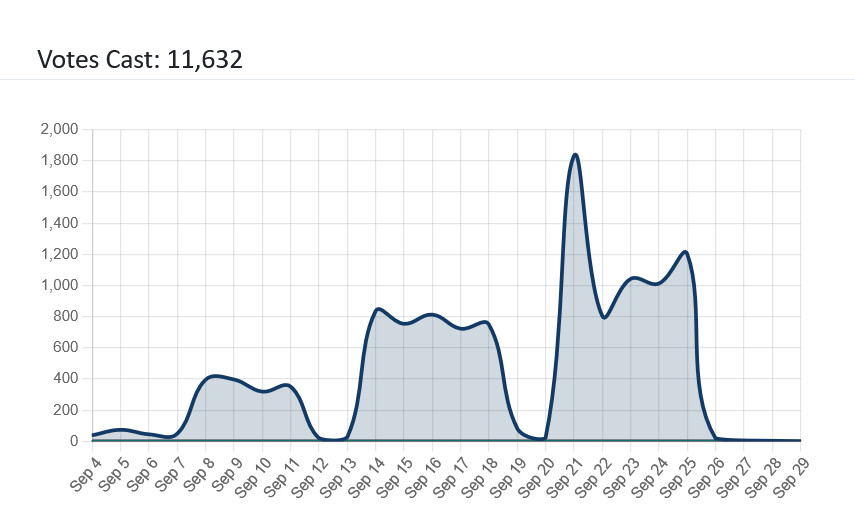
That is less than the 14,003 accepted at a similar point in the last midterm election in 2022. Two caveats:
- County boards have not yet entered all accepted ballots into the statewide system. For example, I wrote last week that 5,540 ballots had been accepted from September 4 through 20. Looking at the same period today, 5,713 ballots have been accepted. That only accounts for about an eighth of the drop from 2022.
- This could be a return to in-person voting for some people who first started voting absentee in 2020 during the COVID-19 scare and continued voting that way in 2022. Fewer absentee votes do not necessarily mean less voting altogether.
The partisan breakdown of the accepted ballots is 47.0 percent Democratic, 37.6 percent unaffiliated, and 15.6 percent Republican. Those numbers are worse for Democrats than at a similar point in 2022, when the breakdown was 52.7 percent Democratic, 31.3 percent unaffiliated, and 15.7 percent Republican.
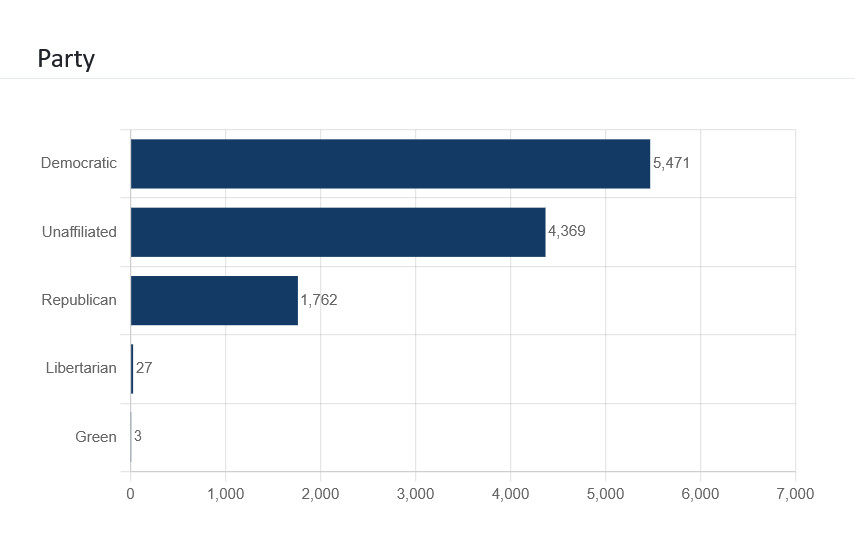
Again, this may simply reflect some voters moving from absentee to in-person voting. Such a change would disproportionately affect Democratic absentee-ballot turnout, since they tended to shift toward that voting method in 2020.
If anything, the number of absentee ballot requests indicates that absentee voting will drop even further compared to 2022. Voters have requested 89,839 absentee ballots so far this year, compared to 129,678 four years ago, a nearly 31 percent drop.
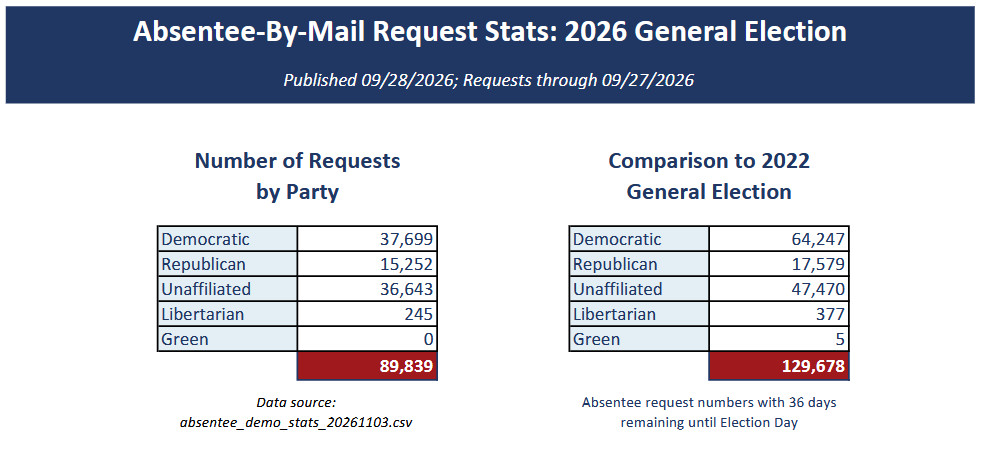
The Democratic share of absentee ballot requests has dropped by 7.5 percentage points, from 49.5 percent in 2022 to 42.0 percent in 2026. Again, however, that is likely due to a move away from absentee voting this year.
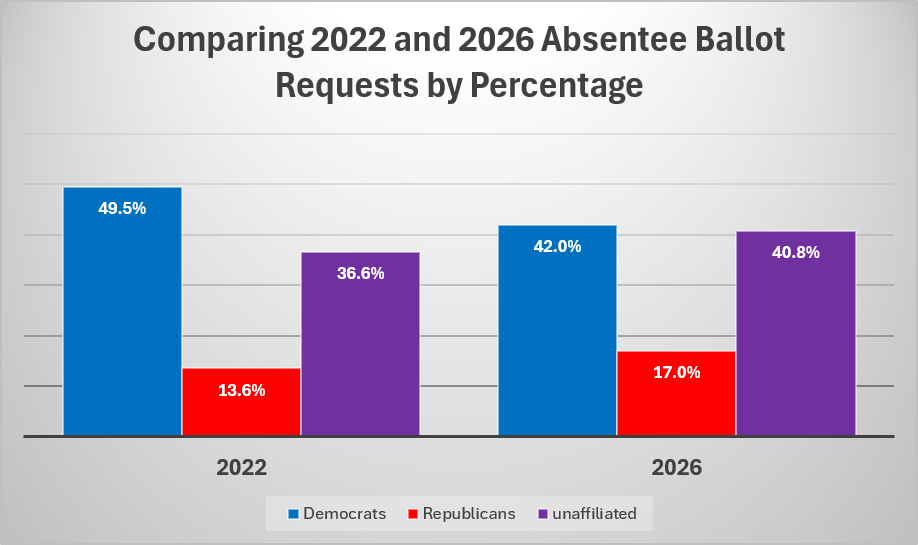
Democrats were 44.2 percent of all absentee voters (not absentee ballot requesters) in 2022 and 41.3 percent in 2018.
Democrats perform relatively well in voter registration
Looking at voter registration starting 15 weeks before election day, both parties are behind where they were in 2018 (the previous Trump midterm election). However, the Democrats have picked up the pace over the past two weeks and will soon be even with their 2018 registration increase total. In the meantime, Republicans have gained less than a third of the registrations they had at a similar point in 2018.
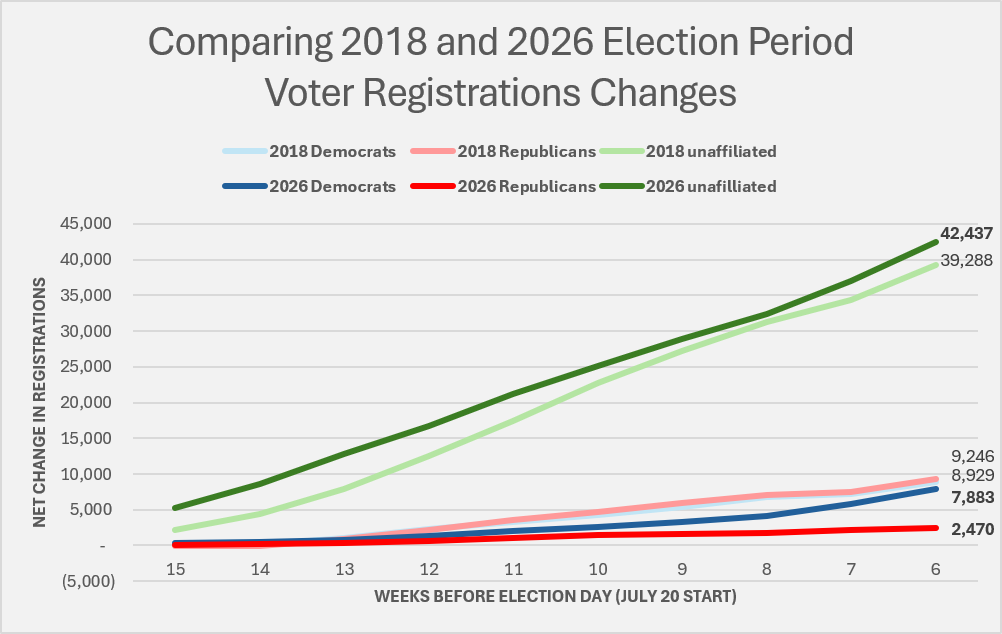
Democrats outgained Republicans by 1,807 registrations this week and are on pace to outnumber Republicans in North Carolina in mid-October. It was only last January that Republicans overtook Democrats to become North Carolina to become North Carolina’s largest party for the first time in state history. Unaffiliated has been the state’s largest registration since early 2022.
While Republicans have been steadily increasing their registration numbers vis-à-vis Democrats for decades, this period of the Democratic Party’s rise is not unique. As seen in the graphic below from the John Locke Foundation’s Voter Registration Changes, the Republican grind towards a two-party majority has periodically been disrupted by rapid Democratic gains during the weeks before election day. The most obvious example is in the 2008 election, when Democrats outgained Republicans by over 250,000 registrations. Even during Trump’s first election in 2016, Democrats outgained Republicans by 5,337 registrations during the last few months before election day.
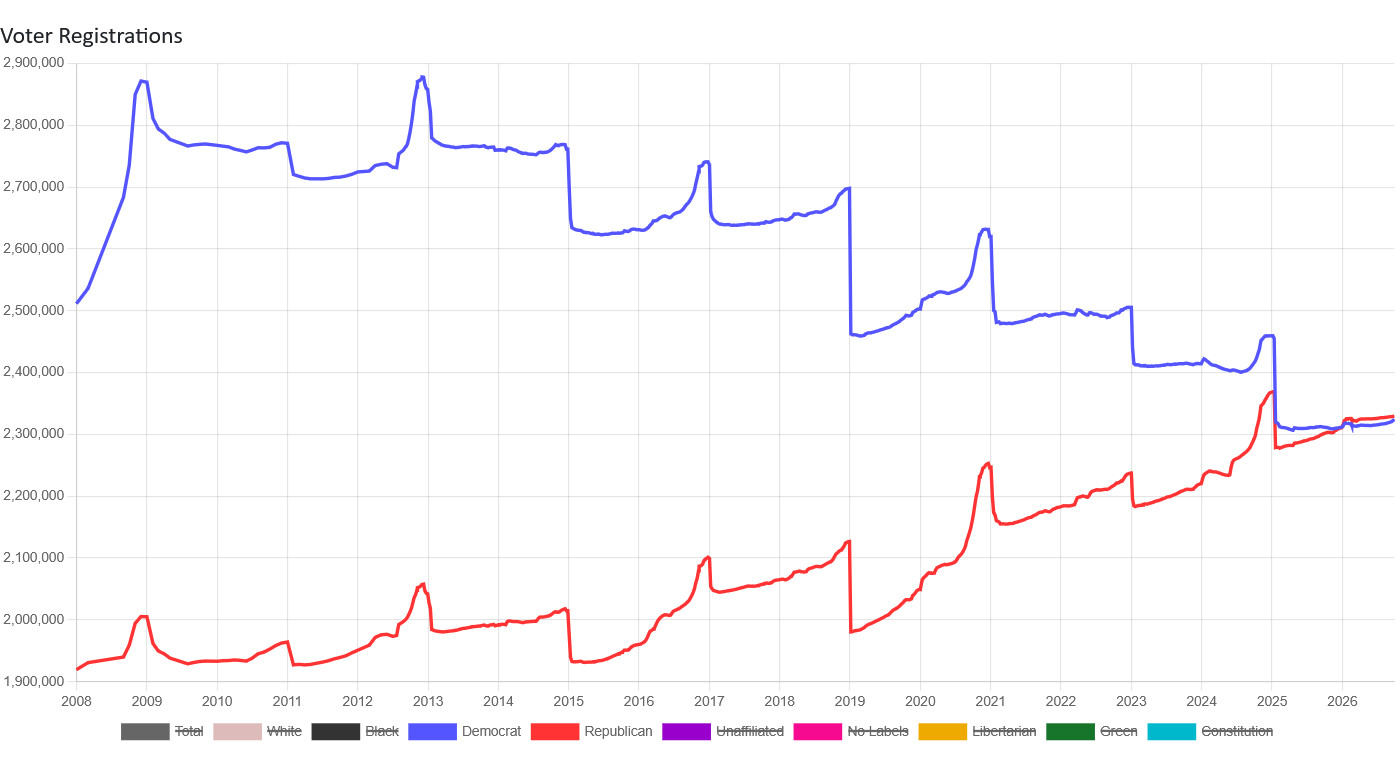
Even if Democrats do emerge back on top in total registrations, that will probably be short-lived. Biennial list maintenance takes place in early 2027, and Democrats will probably lose tens of thousands more registrations than Republicans will.