Scroll down to see what to expect on election night.
Early voting is complete, and tomorrow is election day. After tomorrow, only a small number of military and overseas ballots will be accepted until the county canvasses (when election results become official) on November 13.
Here is the final 2026 election data dump.
Democrats end early voting with the same advantage they had in 2018
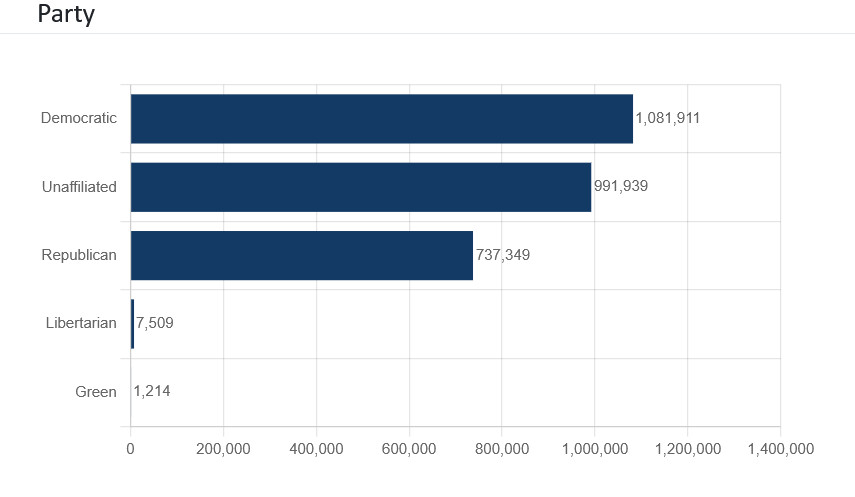
Saturday, October 31 was the last day of early voting. As seen on Vote Tracker, as of the morning of October 26, county boards of elections have accepted 2,819,922 ballots. Election officials had accepted 2,155,459 at the same point in 2022 and 2,042,351 at the same point in 2018.
Democratic vote share (38.4 percent) is 14.2 percentage points higher than Republicans’ (26.2 percent). That is exactly the vote-share gap from the 2018 midterm, which was a good but not tsunami-like election for Democrats. The difference is that unaffiliated voters account for 35.2 percent of total turnout compared to just 26.9 percent in 2018.
Compared with other recent midterm elections, the Republican share is down by over 4.6 percentage points from the average of the 2018 and 2022 midterms. The Democratic share is down 1.9 points, and the unaffiliated share is up almost 6.5 points
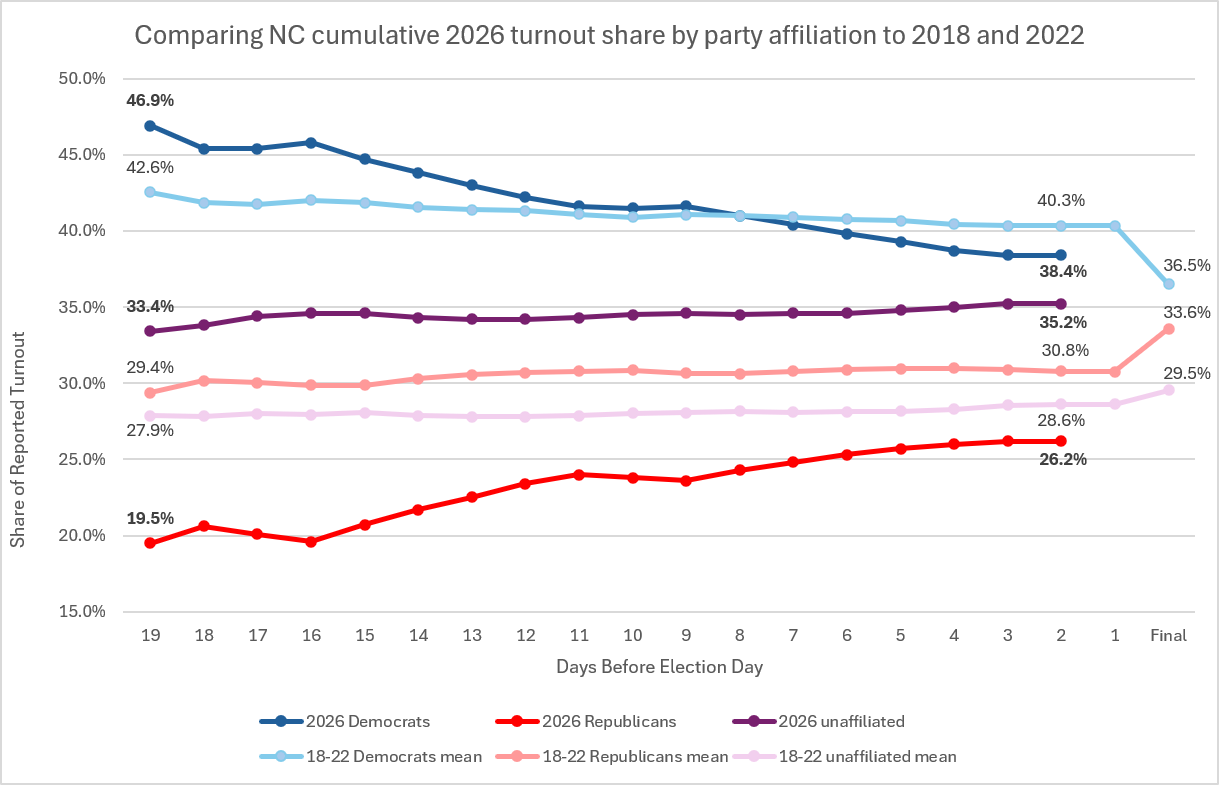
Because voter turnout is up, the 14.2-percentage-point gap between Democrats and Republicans is 344,562 ballots. That same gap represented 253,008 ballots in 2018. An additional unknown is how unaffiliated voters, both early and on election day, will vote.
Absentee voting well off 2022 pace
While overall turnout is up compared to 2022, absentee voting is down. As of the morning of November 2, county election boards have accepted 93,597 absentee ballots. That is well off the 144,569 absentee ballots at the same point in 2022 but ahead of the 70,054 in 2018.
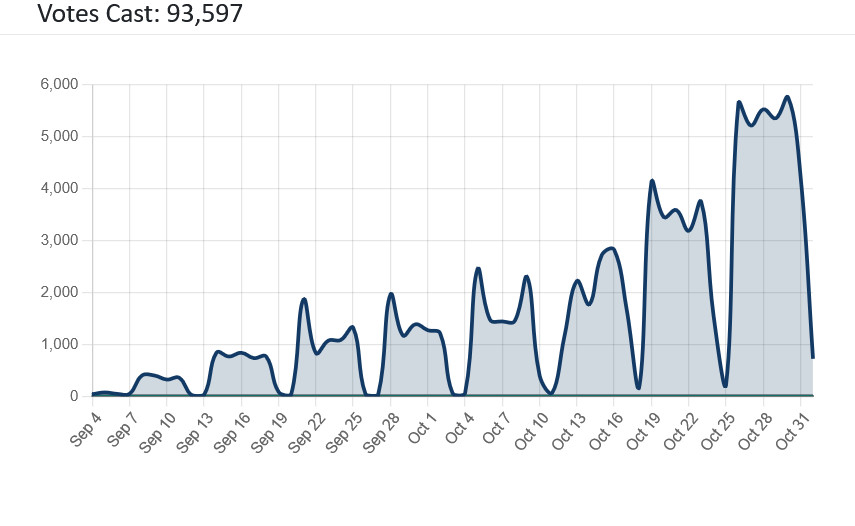
By percentage of all ballots accepted, the 3.3 percent in 2026 is well below the 6.7 percent in 2022 but almost the same as the 3.4 percent in 2018. It appears that the absentee voting rate has returned to its pre-COVID norm.
Republicans perform poorly in voter registration during the 2026 election
Looking at voter registration starting 15 weeks before election day, Democrats end the campaign season slightly ahead of their totals in the last Trump midterm election in 2018. They have gained 29,894 registrations, compared to 26,728 at the same point in 2018. Unaffiliated registration gains are off their 2018 pace, with a net gain of 58,382 compared with 66,942 in 2018.
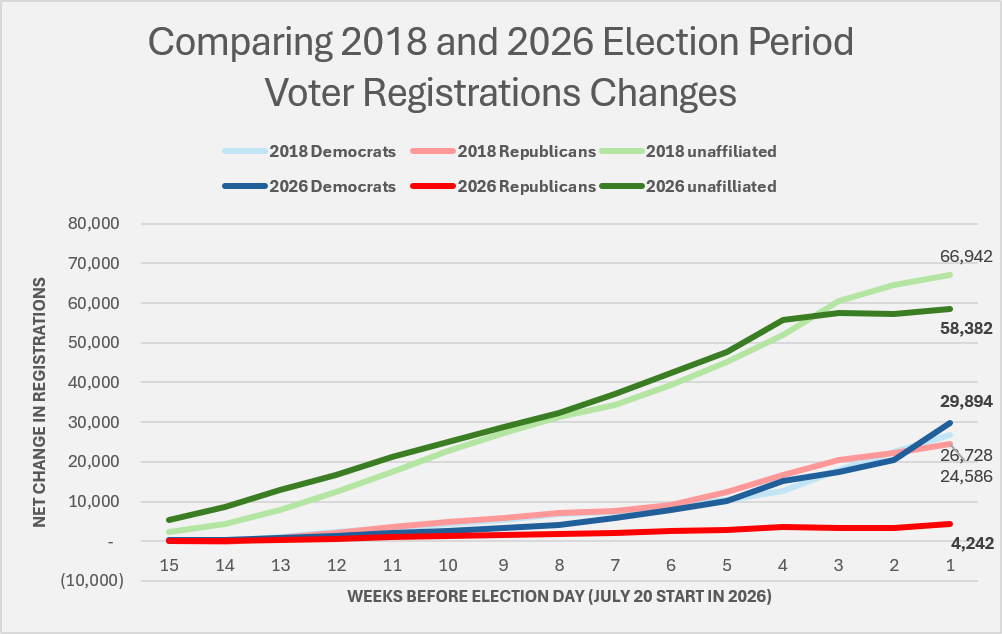
Republicans are well behind where they were at the same point in 2018, with just a net gain of 4,242 compared to 24,586 eight years ago.
What to expect on election night: a likely return of the “red shift”
Polls are scheduled to close at 7:30 PM on Election Day. Anyone who is in line at 7:30 can still vote, so not every voting site will close exactly at 7:30.
In addition, election officials or a judge could order certain locations to remain open for extra time if there is a problem at that site (for example, an electronic poll book malfunction). In that case, the State Board of Elections (SBE) will not release results until all sites have officially closed.
Counties will first release the results from early and absentee voting, which they will have tabulated that afternoon. Then the results from election day will trickle in over the next several hours, and precincts report their returns to their respective county boards of elections, which release the results to the public and pass them on to the SBE. The SBE will then post those results on their election results dashboard as they come in.
Because early and absentee voters are disproportionately Democratic, while election-day voters tend to be more Republican, the order in which results are released makes North Carolina a “red shift” state. As seen in the graphic below of the 2020 presidential race in North Carolina, Democrats tend to start with a large advantage. Republicans then chip away at that throughout the evening.
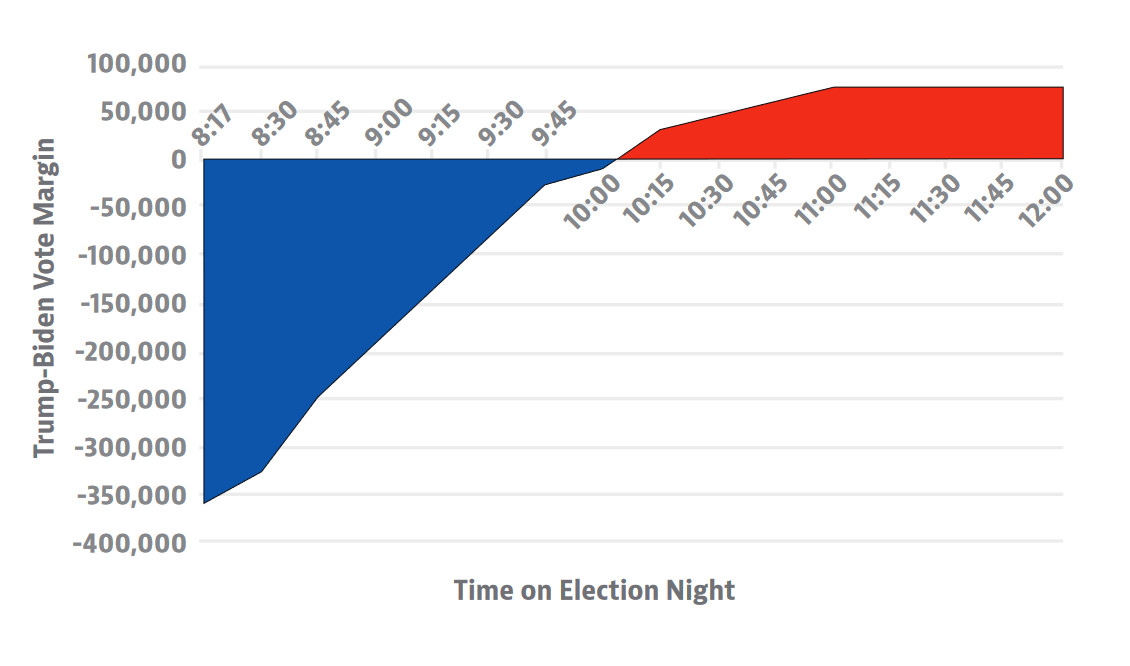
Biden started the evening with a lead of over 350,000. Trump chipped away at that lead through the evening and eventually took the lead at around 10:00 PM. By 11:00 PM, almost all of the ballots had been counted, and Trump’s win solidified at roughly 70,000 votes. If a Republican did not move ahead by 11:00 PM, they probably never would.
Then the General Assembly passed Senate Bill 747 in 2023. While the bill included a host of good election reforms, it also required election boards to wait until polls closed before tabulating early voting ballots. The result was comparative chaos, with county election officials juggling their tabulation work with reporting precinct results. The difference is evident in the jumbled pattern of returns in the chart below, which shows the reported 2024 presidential election results across election night in North Carolina.
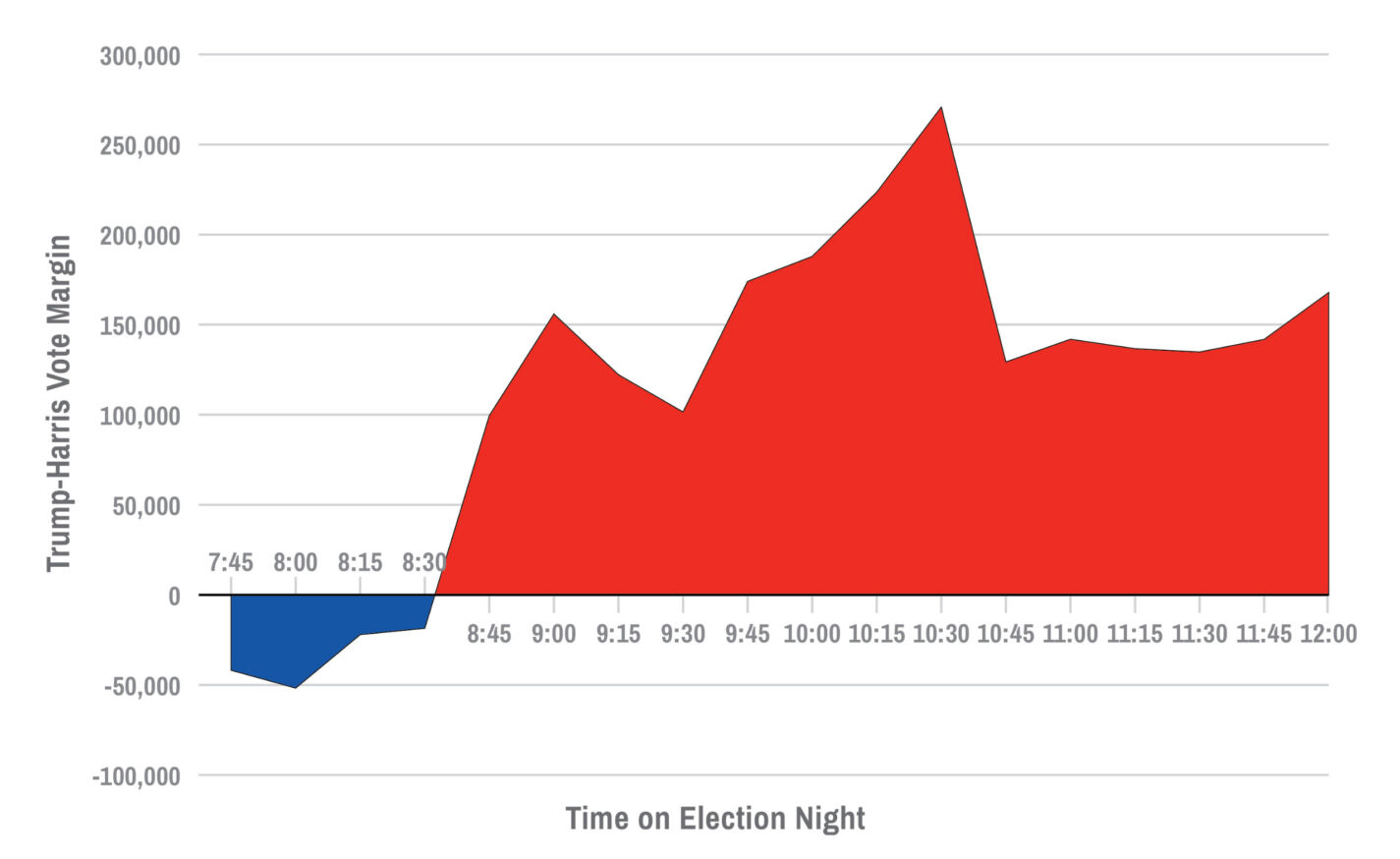
For observers used to the traditional red shift on election night, it looked at 10:30 that Republicans were going to sweep most statewide races. But then the results shifted by about 150,000 votes toward Democrats over the next 15 minutes. In addition, election officials were still releasing large amounts of votes through midnight
House Bill 834, passed in August, allows county boards to count early and absentee ballots between 9:00 AM and 5:00 PM on election day, meaning the majority of ballots will be counted earlier and released as soon as polls close. So we should see a return to the traditional red shifts of the past.