- Election integrity ensures that election results accurately reflect the will of voters
- North Carolina’s score on an election integrity assessment is mediocre
- North Carolina can implement policies to improve the state’s election integrity, including policies that the John Locke Foundation has long recommended
With the 2026 election underway, it is a good time to assess North Carolina’s election integrity standards and how we can improve them. One way to do that is to see how North Carolina stands compared with other states.
What is election integrity, and why is it important?
Election integrity boils down to one question: Are the reported election results an accurate reflection of the will of the legal electorate?
Integrity can be attacked in two ways. First, legitimate voters can be denied the right to vote. Second, the votes of legitimate voters can be canceled out by illegal votes or other forms of fraud.
Both threats have been addressed at various times. Examples include the Voting Rights Act, which overturned laws and practices that denied blacks the right to vote, and Progressive Era reforms, such as voter registration, which countered electoral fraud by political machines.
Despite that, the risk of fraud still exists. As the Heritage Foundation writes:
Recognizing the importance of each individual vote, we must prevent any vote from being erased by a fraudulent vote. Fraudulent votes effectively disenfranchise voters by offsetting and diluting their votes. Although we know that election fraud occurs, it is impossible to measure its full extent and impact. But as the U.S. Supreme Court said in 2008 in Crawford v. Marion County Election Board, “flagrant examples of [election] fraud…have been documented throughout this Nation’s history by respected historians and journalists…[that] demonstrate that not only is the risk of voter fraud real but that it could affect the outcome of a close election.”
That last point is especially important. Election fraud does not need to involve massive numbers to alter election outcomes. That is especially true in North Carolina, which has had some very close elections recently.
As a report in The American Economist points out, “Voter fraud is usually difficult to detect without costly monitoring and investigation costs, especially in light of mail-in votes and failure to require picture IDs.” So, it is more effective to prevent fraud through secure systems than to detect and prosecute it afterward. North Carolina requires photo IDs to vote.
North Carolina is mediocre on an election integrity scorecard
Election laws and regulations are set by states and enforced by state and local election administrators.
Given that reality, how well do states secure their election systems?
The Heritage Foundation seeks to answer that question through an election integrity scorecard. The scorecard grades states on how well they provide secure elections across 15 policy areas.
The range of scores on the 100-point scale is from a low of 22 points for Hawaii to 87 for Tennessee.
So, how does North Carolina rate on the election integrity scorecard?
Middling.
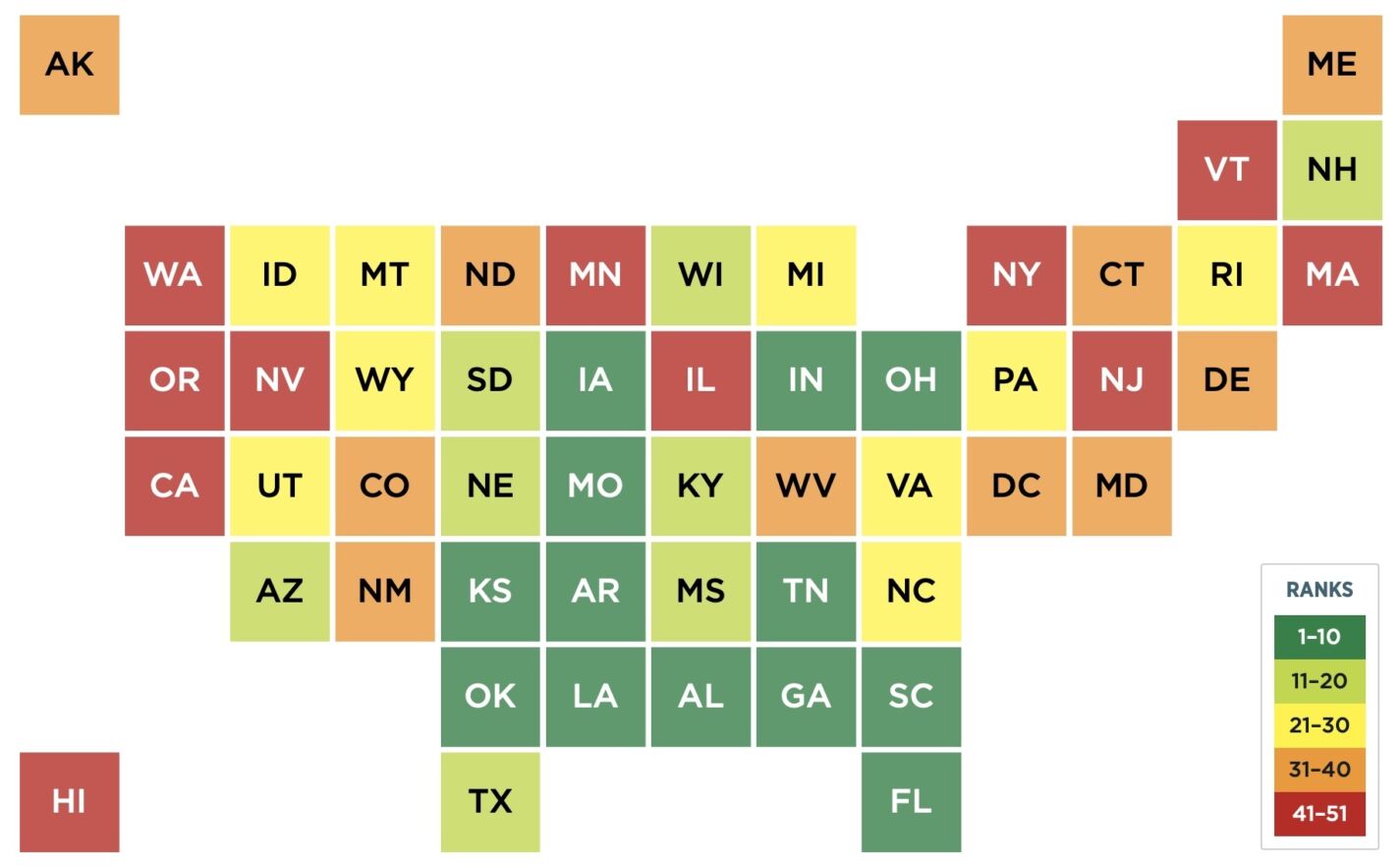
Stylized United States map showing tiered state rankings on election integrity. Source: Heritage Foundation
The Tar Heel State earned a score of 59, making it tied with two others as the 22nd-best state for election integrity. Looking at adjacent states, in addition to Tennessee, Georgia (77 points) and South Carolina (71 points) scored higher, while Virginia (55 points) was slightly lower.
There are a couple of areas where Heritage’s assessment of North Carolina election policy may be outdated or too harsh.
For example, the scorecard asserts that North Carolina does not require receipt of all ballots by the close of polls on election day, except for overseas military ballots. But the General Assembly did set election day as the deadline for all ballots except military and overseas ballots (which can be accepted up to nine days after election day) with the passage of Senate Bill 747 in late 2023.
The scorecard also states that the North Carolina State Board of Elections (SBE) does not use the Systematic Alien Verification for Entitlement (SAVE) Program to help identify noncitizens who register to vote. However, the SBE has long used SAVE to check the citizenship status of individual voters and will soon use it on a more systematic basis. In the meantime, the SBE is checking the citizenship status of registered voters whose SAVE program data indicate they may not be citizens.
Improving election integrity in North Carolina
Even with that caveat, the Heritage scorecard indicates that there is much North Carolina policymakers can do to make our elections more secure and better run. The John Locke Foundation has already suggested many of the ways the state can improve its standing. Here is a sample (Heritage frames its suggestions as questions):
“Election officials [should] investigate the registrations of individuals registered at the same address with only slight discrepancies in their names”
While election officials remove tens of thousands of registrations each year with “duplicate” as the stated reason, these removals are mainly for people who have moved to a new county or changed their information (such as party affiliation), rather than for two similar registrations with the same name and ages. The General Assembly should streamline the current, clunky system for duplicate registration challenges. Even better, election officials should take a more active approach to investigating apparent duplicate registration.
“The state [should share] voter registration information with four or more other states that it compares with its voter registration data to remove or put in suspense individuals who are registered in multiple states”
North Carolina should join the Electronic Registration Information Center (an interstate voter registration data-sharing program), but only after passing reforms to ensure data privacy. Another option would be to enter into bilateral data-sharing agreements with neighboring states.
“State or local officials, or independent outside auditors, [should] perform a post-election audit of the procedures and processes, or an effective portion of them, to verify that state and federal election laws and regulations were followed, including those requiring maintenance of an accurate voter registration list”
The John Locke Foundation has advocated for independent performance, or procedural, audits since 2023 (pages 151–153). House Bill 958 includes performance audits. The General Assembly passed it in August, but Gov Josh Stein vetoed it. The legislature may attempt an override vote after the election.
The General Assembly and the State Board of Elections should institute these and other reforms to improve election integrity (and increase its score on Heritage’s scorecard).