- Too often, prosecutors take no action against alleged election law violations
- Current law allows “any registered” voter in a district to petition the superior court in that district to appoint a special prosecutor for alleged campaign finance violations
- That law should be expanded to cover other alleged election law violations
Prosecutors are often reluctant to bring charges in election fraud cases since they can be difficult to prosecute. One way to correct that problem is to expand the special prosecutor law for campaign finance violations to include election fraud.
Prosecutors too often ignore alleged election law violations
Last December, the John Locke Foundation reviewed alleged election law violations in the 2010 race for Yancey County sheriff. That race was a statistical anomaly, with absentee ballots cast at more than six times the average for North Carolina’s other 99 counties. Absentee ballots are “uniquely vulnerable to fraud.”
As detailed in the December report, there was extensive evidence of absentee ballot fraud in that race:
- Sheriff’s Department Capt. Judy Ledford delivered absentee ballots to voters and took possession of them after the voters completed them (a felony under North Carolina law). Sheriff Gary Banks later claimed that the voters’ “memory is incorrect” about Ledford taking their ballots.
- Chief Deputy Tom Farmer approached a convicted felon with charges pending and “offered to reduce charges that had been filed against him in return for his vote.” That person then voted illegally (it is illegal for felons to vote before completing their whole sentence, including probation or parole).
- Several other felons also voted illegally.
Election officials gathered evidence and presented it to District Attorney Gerald Wilson, who promptly did nothing.
As former North Carolina State Board of Elections (SBE) Executive Director Gary Bartlett pointed out, that lack of action by investigators and prosecutors has been an unfortunate pattern: “We’ve reported it. We’ve had the (State Bureau of Investigation) turn us down. There have been referrals (to local prosecutors), and nothing has been done.”
A section of state law would allow citizens to request that the superior court in that district appoint special prosecutors to investigate suspected campaign finance fraud. That law could be extended to cover allegations of election fraud, but problems with its application must be corrected first.
How the campaign finance special prosecutor law has been undercut
North Carolina General Statute (G.S.) § 163‑278.28(b) states, in part:
If the Board makes a report to a district attorney under G.S. 163‑278.27 and no prosecution is initiated within 45 days after the report is made, any registered voter of the prosecutorial district to whose district attorney a report has been made, or any board of elections in that district, may, by verified affidavit, petition the superior court for that district for the appointment of a special prosecutor to prosecute the individuals or persons who have or who are believed to have violated any section of this Article.
G.S. § 163‑278.27 makes it a duty for election officials to report campaign finance violations to district attorneys and for district attorneys to prosecute alleged offenders upon receipt of those reports.
But citizens must be aware of the allegations before they can file a petition for a special prosecutor.
In response to a public records request for “a list of all reports made to prosecuting authorities under GS 163‑278.27 since January 1, 2016,” the SBE sent the following reply:
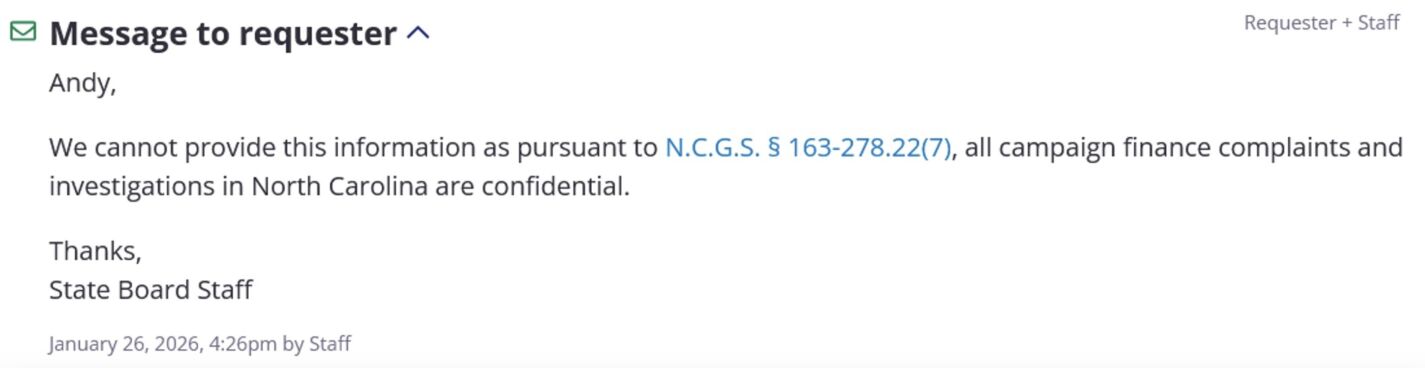
Indeed, G.S. § 163-278.22(7) states that “all investigations shall be confidential.” That language was added to the law as part of House Bill 1029, which passed in 2018.
Nevertheless, it was not the intent of legislators when they passed HB 1029 for this confidentiality to continue after referrals were made to prosecuting authorities:
[Senate leader Phil] Berger said the bill would keep campaign-finance complaints confidential unless the State Ethics Commission reviewed them and recommended criminal prosecution. At that point, the information would become public.
In addition, the SBE’s Campaign Finance Complaint Policy states that “closure reports,” which are made once SBE staff complete their investigation, are not considered confidential (page 8):
While it may be informed by information or materials gathered or generated during an investigation, the closure report is not a record of the investigation, and therefore is not confidential.
So, voters should be able to use information from a closure report to request a special prosecutor if officials make it available.
Expand the special prosecutor petition law to other election crimes
There are two aspects of campaign finance law that should be emulated in laws on other kinds of election fraud.
The first is that it should be a duty for election officials to report credible accusations of election fraud to district attorneys and for district attorneys to prosecute alleged offenders upon receipt of those reports.
Election boards focus on whether fraud was “sufficient in number to change the outcome of the election,” not on individual cases of election fraud. The SBE still has a duty to report suspected cases of fraud or other irregularities to the State Board of Elections, however (G.S. § 163‑22(d)):
The State Board shall investigate when necessary or advisable, the administration of election laws, frauds and irregularities in elections in any county and municipality and special district, and shall report violations of the election laws to the State Bureau of Investigation for further investigation and prosecution.
As previously noted, “further investigation and prosecution” does not always happen.
The General Assembly should amend G.S. § 163‑22(d) to allow registered voters to petition the superior court in their district for the appointment of a special prosecutor to investigate criminal election fraud actions in cases where the State Bureau of Investigation does not take action.
There should be no need to change the law regarding reported campaign finance violations, as they should already be publicly available. The SBE should, however, maintain a public list of alleged election law violations (including campaign finance violations) referred to prosecutors or investigators.
This change should not lead to a rash of special prosecutors, but the threat of their deployment may cause prosecutors to take election fraud reports more seriously.