It is 22 days until election day on November 3. The deadline for regular voter registration was October 9.
Here are some relevant upcoming dates from the North Carolina State Board of Elections:
- Oct. 15: Early voting begins (same-day registration available)
- Oct. 20: Absentee ballot request deadline (5 p.m.).
- Oct. 31: In-person early voting ends (3 p.m.).
- Nov. 3: Election Day (Deadline for most absentee ballots)
With the start of early voting, we will have access to more substantial data in next week’s data dump.
Absentee voting continues to trail 2022 levels
As seen on Vote Tracker, county boards of elections have accepted 28,304 ballots through October 11.
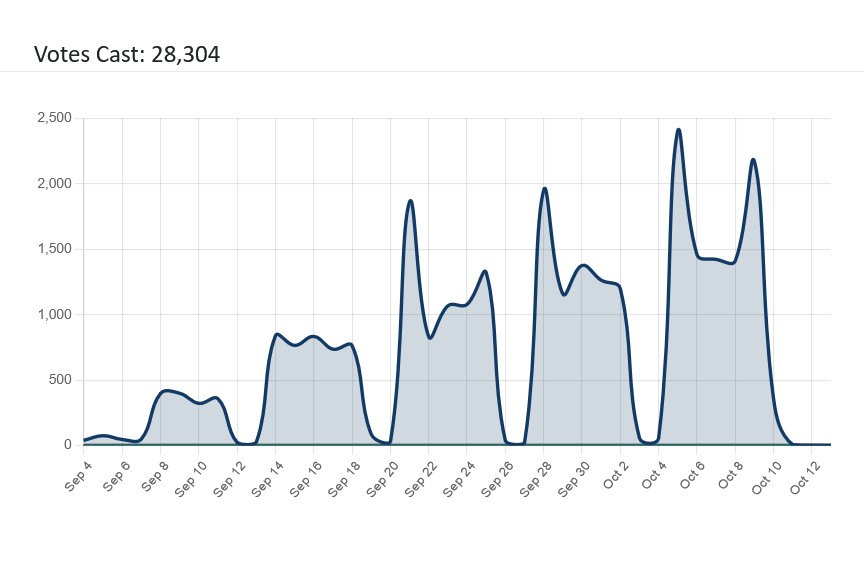
That is a 23 percent decline from a similar point in 2022. As noted in last week’s data dump, the most likely explanation for the drop is voters returning to in-person voting rather than choosing not to vote:
Why is turnout down so much?
It is possible that the drop represents general disgust with politics and a refusal by citizens to participate in the process.
A more likely explanation, however, is that voters are returning to in-person voting after voting absentee in 2020 during the COVID-19 scare and continuing to vote that way in 2022. An NBC poll found that the share of Democrats planning to vote by mail declined by a third, from 34 percent in 2024 to 23 percent. Republican intention to vote by mail remained low in the survey at 12 percent.
Fewer absentee votes do not necessarily mean less voting altogether. We could see the share of people voting early in person or on election day increase.
Since Democrats disproportionately shifted toward absentee voting during the COVID era, the apparent shift back to in-person voting would also affect them more. That is supported by the data.
The partisan breakdown of the accepted ballots is 44.7 percent Democratic, 38.3 percent unaffiliated, and 16.7 percent Republican. At a similar point in 2022, it was 50.0 percent Democratic, 33.4 percent unaffiliated, and 16.4 percent Republican.
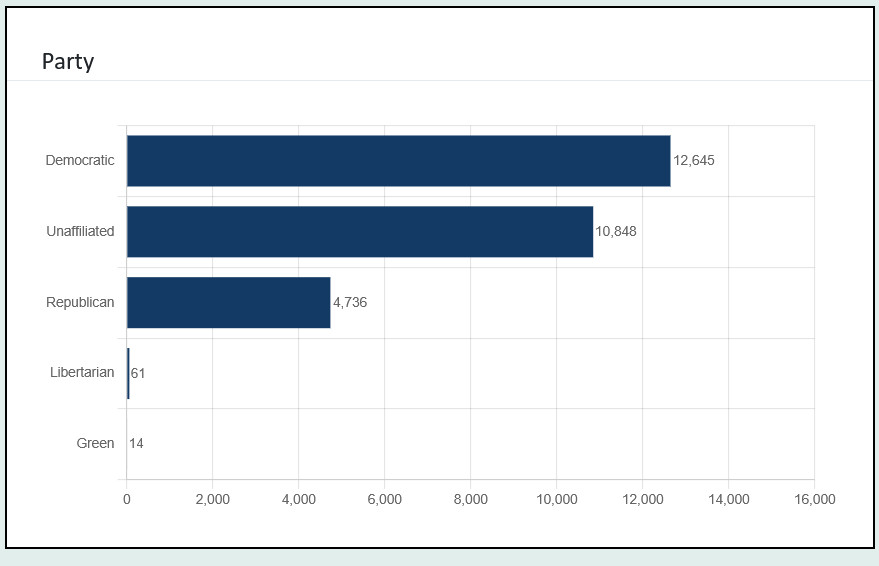
Democratic ballots are down 31.2% compared to a similar point in 2022, while Republican ballots are down 21.4%, and unaffiliated ballots are down just 11.6%.
Expect the absentee ballot decline to continue
The number of absentee ballot requests indicates that absentee voting will drop even further compared to 2022. Voters have requested 128,431 absentee ballots so far this year, compared to 191,280 four years ago. That is a decline of 32.9 percent.
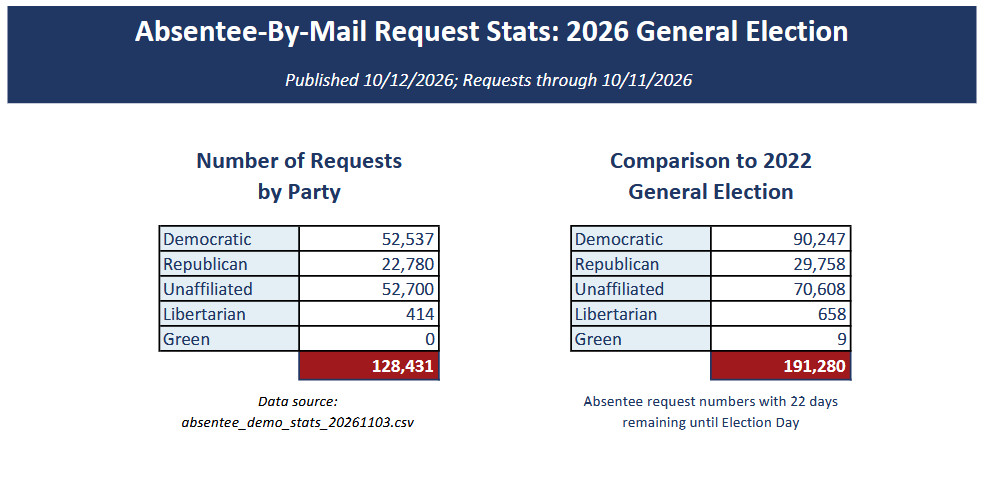
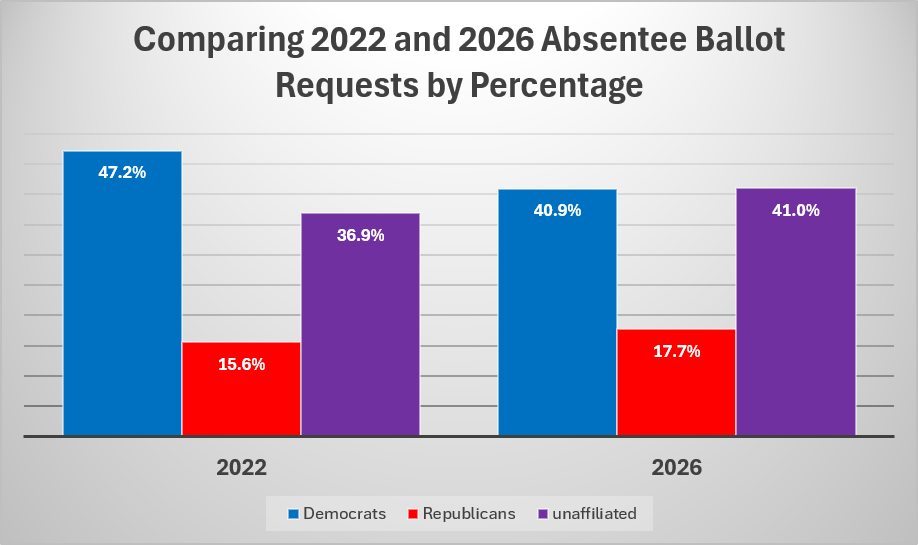
The Democratic share of absentee ballot requests has dropped by 6.3 percentage points, from 47.2 percent in 2022 to 40.9 percent in 2026. Again, however, that is likely due to a move away from absentee voting this year. The unaffiliated proportion rose by 4.1 percentage points, and the Republican proportion rose by 2.1 percentage points.
Democrats were 44.2 percent of all absentee voters (not absentee ballot requesters) in 2022 and 41.3 percent in 2018.
Democrats retake the largest party spot
Looking at voter registration starting 15 weeks before election day, Democrats are once again North Carolina’s largest political party. Republicans had taken the top spot last January for the first time in state history.
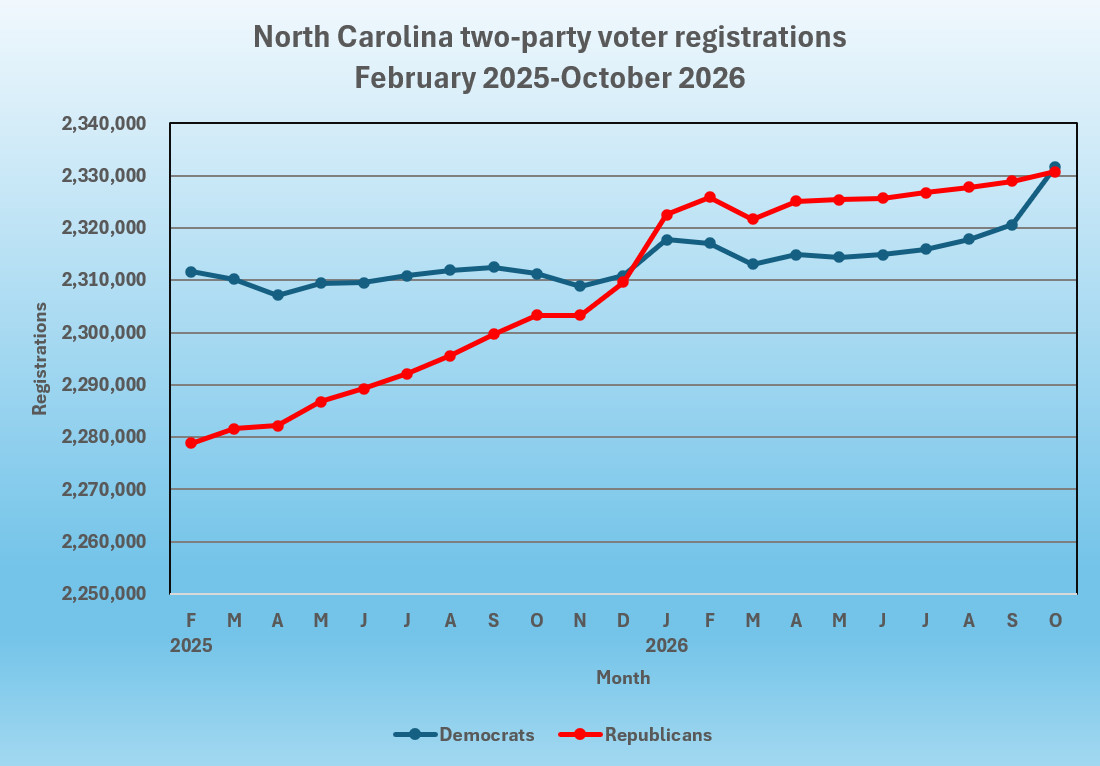
Unaffiliated is the most numerous registration.
In North Carolina, 40.2 percent of all voters are unaffiliated, 29.58 percent are Democrats, and 29.57 percent are Republicans.
Democrats are keeping up their 2018 pace, with a net gain of just over 15,000 registrations. The real story, however, is one of Republican decline. Republicans are about 13,000 registrations behind where they were at the same point in 2018, in terms of registration gains.
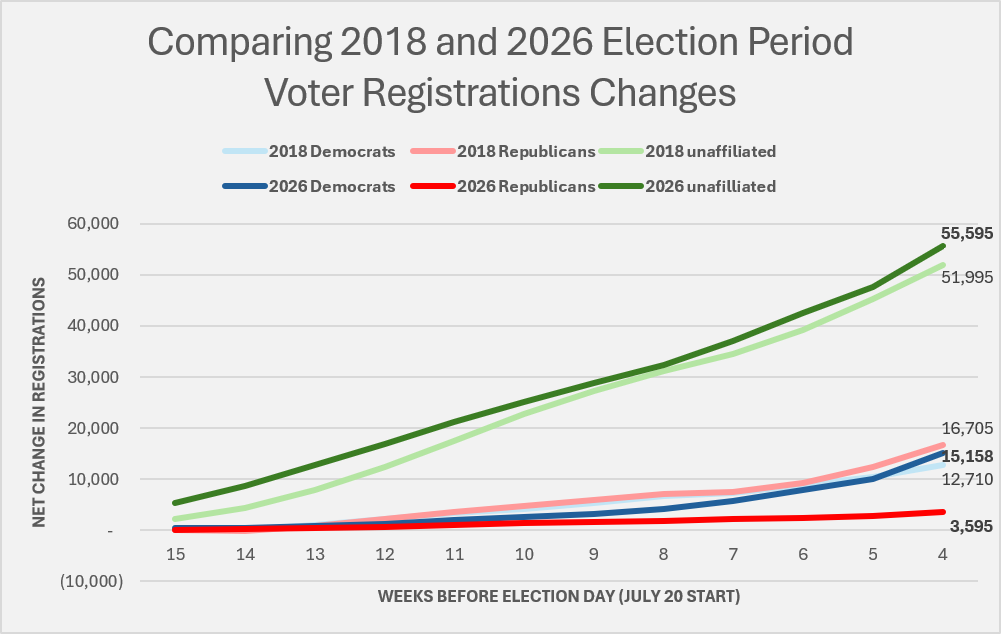
The two caveats I have posted recently still apply:
- Democrats tend to do well in voter registration during election season and regularly, though not always, outpace Republicans in the weeks before election day.
- Republicans will almost certainly regain the top-party spot during biennial list maintenance in January.
In any case, the impact of a shift of about 12,000 registrations in a state with almost eight million is minimal. It is, however, a moral boost for Democrats.
Again, more substantial data will be available in next week’s data dump, with several days of early voting to report.